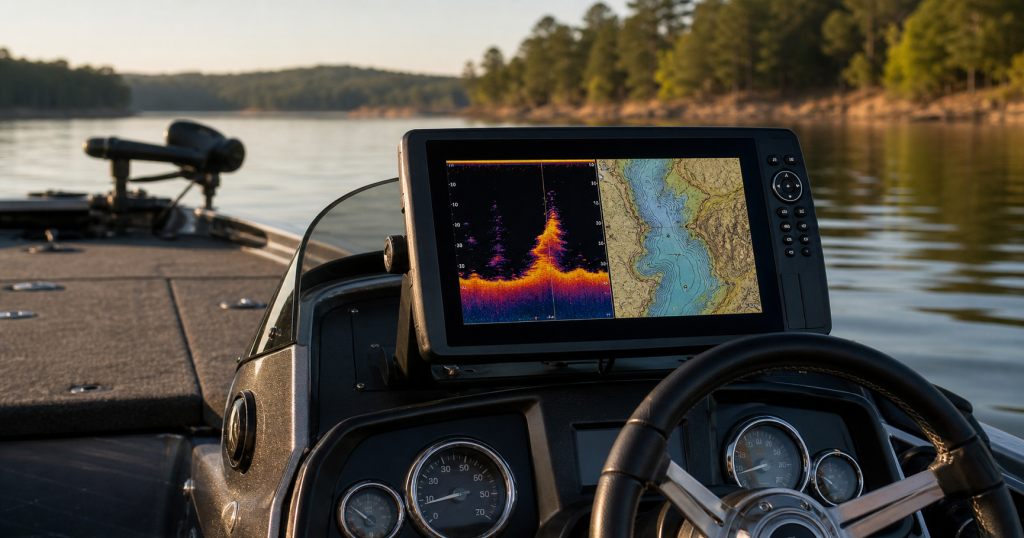
We tested Garmin, Humminbird, and Lowrance graphs on real bass water—compare CHIRP, side imaging, mapping, and our top picks for boats and kayaks.
Finding bass is rarely about luck alone. On modern reservoirs and natural lakes, the fish stack on ledges, roam offshore bait, or tuck into shoreline cover that all looks identical from the surface. A quality fish finder turns that guesswork into a repeatable process: you see depth changes, spot suspended shad, confirm brush pile height, and know whether your crankbait is actually running through the strike zone. This guide is built for serious bass anglers—from weekend tournament anglers to kayak fishermen—who want clear sonar, useful mapping, and a realistic upgrade path without overspending on features they will never use.
Bass move with season and water clarity, and your graph should keep up. Prespawn fish stage on channel swings visible as subtle breaks on 2D; spawn fish hug hard bottom you can verify with down imaging; post-spawn schools suspend over timber that only shows up when side scan is tuned for range, not just max gain. Summer ledge fish often relate to bait at specific depths on thermoclines—situations where noisy, low-contrast sonar wastes hours. The models in this guide were chosen because they answer real bass-fishing questions: Where is the cleanest hard bottom? Is that arch a bass or a drum? Can I mark this brush pile and return to it in a crosswind?
If you are still narrowing your search, our dedicated hubs break down the category in more depth: browse all fish finders, bass-specific tactics in bass fishing, compact installs in kayak fishing, and networking, trolling motors, and forward-facing sonar in fishing electronics. We may earn a commission when you purchase through links on this page; that support funds the publication. Recommendations are research-based unless a specific item is labeled FIRSTHAND. Prices are approximate and change frequently—always check current pricing before you buy.
Quick Picks: Best Fish Finders for Bass (2026)
Short on time? These three units cover the most common bass scenarios: a full-featured bow graph for the bass boat, a strong mid-range side-imaging option, and a kayak-friendly CHIRP unit that still reads bottom detail in wind chop.
Best Overall
Garmin Echomap UHD 93sv
Check current price
Nine-inch clarity, excellent SideVu and ClearVu, LakeVu mapping, and a clean path to Livescope and Panoptix networking.
See Current PriceBest Value
Humminbird Helix 7 CHIRP MEGA SI
Check current price
MEGA Side Imaging and Dual Spectrum CHIRP on a proven Helix platform—hard to beat for offshore structure fishing on a budget.
See Current PriceBest for Kayak
Garmin Striker Vivid 7sv
Check current price
Bright color palettes, CHIRP traditional and ClearVu, built-in GPS, and a footprint that fits most kayak dashboards.
See Current PriceHow This Guide Was Evaluated
Evidence classification: EDITORIAL ASSESSMENT. This comparison is based on documented manufacturer specifications, manuals, mapping and accessory compatibility, installation requirements, and use-case fit. It is not presented as a controlled hands-on test of every unit.
We compare the questions that matter on a bass boat or fishing kayak: screen readability, included transducer and supported sonar views, side-imaging capability, mapping, networking and forward-facing-sonar upgrade paths, power and mounting demands, and the cost of accessories needed to complete an installation. Specifications can vary by bundle and model year, so verify the current manufacturer page and included transducer before buying.
No numerical star score is shown because The Anglers Hub does not yet have a documented repeatable scoring program for these products. “Best for” labels are editorial fit judgments, not laboratory rankings or customer-review aggregates.
Specifications and availability reviewed: August 28, 2026. Prices and bundles change; use retailer links only to check current terms.
Bass Fish Finder Comparison Chart
Use this table to compare core specs and intended use. All models below are discussed in detail in the model-by-model assessment.
| Model | Price | Screen | Sonar | Best For |
|---|---|---|---|---|
| Garmin Echomap UHD 93sv | Check current price | 9″ | UHD SideVu/ClearVu + CHIRP | Best overall bass boat graph |
| Humminbird Helix 7 CHIRP MEGA SI | Check current price | 7″ | MEGA SI/DI + Dual CHIRP | Best value side imaging |
| Lowrance Elite FS 9 | Check current price | 9″ | Active Imaging 3-in-1 | Best Lowrance ecosystem |
| Garmin Echomap UHD 73sv | Check current price | 7″ | UHD SideVu/ClearVu + CHIRP | Best mid-size Garmin |
| Garmin Striker Vivid 7sv | Check current price | 7″ | CHIRP + ClearVu | Best kayak / budget CHIRP |
| Lowrance Hook Reveal 7 | Check current price | 7″ | Fish Reveal + DownScan | Budget Lowrance SI |
| Humminbird PiranhaMAX 4 | Check current price | 4.3″ | DualBeam sonar | Ultra-budget backup unit |
Scroll horizontally on small screens to view all columns.
Detailed Reviews: Best Bass Fish Finders
Below we walk through each recommended model in the order most bass anglers should consider them: flagship graphs first, then mid-tier workhorses, then kayak and budget picks. Read the prose between reviews for technique-specific advice—how each sonar type fits flipping, offshore ledge fishing, and forward-facing sonar upgrades.
Why the Right Graph Matters More Than “More Sonar”
Bass anglers often overspend on screen size and underspend on transducer quality. A nine-inch display is worthless if your transducer is mounted in aerated water behind a stepped hull; conversely, a skilled angler with quality CHIRP and clean install can outfish a cluttered giant screen. Before you choose a model, decide your primary fishing style. Shallow power-fishing around cover rewards fast refresh rates and responsive 2D sonar. Offshore structure fishing rewards side imaging range and reliable waypoint management. Forward-facing sonar addicts need a unit with open ecosystem compatibility—Garmin Livescope, Humminbird MEGA Live, or Lowrance ActiveTarget—rather than a closed budget box that cannot grow with your boat.
With that framing, our top overall pick for 2026 remains the Garmin Echomap UHD 93sv for anglers running a dedicated bass boat who want one unit that handles map navigation, side structure search, and future forward-facing sonar without a full network rebuild.
Garmin Echomap UHD 93sv
Check current price
Our top overall bass boat graph for 2026—UHD side imaging clarity, strong mapping, and the cleanest upgrade path to Livescope.
Pros
- Crisp UHD SideVu and ClearVu
- Excellent LakeVu cartography
- Network-ready for Livescope
- Responsive touchscreen
Cons
- Premium price
- Accessories add up quickly
- Menu depth takes practice
On the water, the Echomap UHD 93sv is the unit we trust when a tournament pattern depends on reading offshore brush and subtle rock veins the same way every pass. Garmin’s UHD side imaging shows sharper contrast between hard bottom and silt, which matters when bass position on inside turns versus main-lake ledges. ClearVu down imaging helps confirm whether fish are actually relating to the top of brush or suspending above it—a detail that changes jig head weight and trailer selection. Traditional CHIRP channels stay readable at higher boat speeds than older non-CHIRP units, so you can idle scan a point then spin around for a cast without re-tuning gain from scratch.
Mapping is a major reason this unit tops our bass list. LakeVu g3 cartography with Auto Guidance+ (where supported) makes running creek channels safer early in the morning, and Quickdraw Contours lets you log community or private map detail after a day of scanning. For bass anglers who fish multiple lakes, the consistency of Garmin’s map UI reduces mental overhead—you are not relearning menus every weekend. Networking is equally important: this platform is Livescope-ready when you add the appropriate black box and transducer, and it plays well with Force trolling motors and NMEA 2000 accessories serious tournament rigs expect.
If you fish ledge lakes (Ozark highland reservoirs, TVA impoundments, many Texas lakes), the 93sv’s screen real estate matters. Split-screen views with full-size side imaging plus map help you mark waypoints on brush piles while watching for bait schools entering the cone. Shallow anglers who never look past the shoreline may be happier saving money on a seven-inch model, but for offshore-focused bass fishing, the nine-inch panel is not vanity—it is workflow.
Tournament anglers will appreciate ActiveCaptain connectivity for sharing waypoints across units and quick access to community data where available. Even if you never share a spot, the workflow of marking, labeling, and returning to offshore waypoints is smoother on a large touchscreen than on cramped budget interfaces. Pair the 93sv with a high-quality trolling motor transducer mount if side imaging is your primary search tool—on many bass boats, that single install upgrade matters more than jumping from a seven-inch to nine-inch screen.
Garmin’s Seven-Inch Sweet Spot and Humminbird’s Value King
Not every bass boat needs a nine-inch bow hero. Smaller consoles, side-console rigs, and second graphs often fit seven inches better. Garmin’s Echomap UHD 73sv trims cost while keeping UHD side imaging and ClearVu—the same sonar stack that makes the 93sv special, in a package that still networks for Livescope when you are ready. On the Humminbird side, the Helix 7 CHIRP MEGA SI remains the value benchmark: MEGA Side Imaging has been the gateway drug to offshore bass fishing for a decade, and Dual Spectrum CHIRP keeps shallow fish from smearing into blobs.
When choosing between these mid-tier flagships, think about map loyalty. Garmin anglers should stay in Echomap for seamless Livescope upgrades; Humminbird anglers who already own LakeMaster chips and Minn Kota One-Boat Network parts will be happier staying in Helix rather than mixing ecosystems. Both brands support forward-facing sonar on appropriate models—Humminbird via MEGA Live compatibility on Helix units, Garmin via Livescope—so your decision is less “which brand invents sonar” and more “which menu language and dealer support you already trust.”
Garmin Echomap UHD 73sv
Check current price
The best seven-inch Garmin for bass anglers who want UHD imaging and Livescope readiness without paying for a nine-inch panel.
Pros
- UHD SideVu/ClearVu at lower cost
- Livescope upgrade path
- Solid LakeVu maps
- Smaller console footprint
Cons
- Less screen than 93sv for split views
- Still mid-premium pricing
- Networking extras cost extra
The 73sv earns its place for anglers running a single graph on a Ranger RT188-class boat or adding a second unit at the helm. Side imaging range is comparable to the larger sibling for practical bass fishing distances; you are mainly giving up workspace when running three-panel splits. Install the transducer on the trolling motor when possible for cleaner side returns at slow idle speeds—critical when hunting isolated stumps on flats.
For shallow cover fishing, pair traditional CHIRP with down imaging in a horizontal split. Watch for perch or shad flickers above brush—bass often sit below bait on post-spawn lakes. When you mark fish, drop a waypoint and circle back with forward casts rather than hovering directly above; side imaging works best when you are not on top of the structure.
Humminbird Helix 7 CHIRP MEGA SI
Check current price
Best value side-imaging bass graph—MEGA SI still finds offshore structure faster than basic 2D alone.
Pros
- Excellent MEGA Side Imaging
- Dual Spectrum CHIRP
- LakeMaster friendly
- Proven Helix interface
Cons
- Not the newest Helix generation UI
- Networking can feel modular
- Screen size limits triple splits
Helix 7 MEGA SI is where budget-conscious tournament anglers should look first. Humminbird’s MEGA imaging clarifies rock piles and road beds on Tennessee River-style fisheries, and the unit remains relevant because LakeMaster mapping and Minn Kota integration are mature. If you fish stained water, lean on CHIRP with slightly higher sensitivity rather than cranking legacy 200 kHz modes that bloom in clutter.
Upgrade note: Helix units in this class are the foundation for MEGA Live forward-facing sonar when you add compatible transducers and modules. If Livescope-style fishing is your endgame but you prefer Humminbird maps, plan your purchase around Helix networking from day one rather than buying a non-expandable budget box now.
Lowrance Elite FS 9 and the Three-Brand Ecosystem Decision
Lowrance sits in a three-way fight with Garmin and Humminbird for bass boat dominance. The Elite FS 9 is Lowrance’s answer to the Echomap 93sv: a nine-inch Active Imaging machine with excellent down and side scans, smooth touch response, and deep integration with Ghost trolling motors and ActiveTarget forward-facing sonar. Bass anglers already running Lowrance on the console often add FS series graphs for matching palettes and shared waypoints across HDS Live and Elite lines.
Active Imaging 3-in-1 transducers simplify install—one puck, multiple views—which matters when you do not want separate transducers cluttering the jack plate. For ledge lakes, FS 9’s down scan clarifies small rock fingers that hold summer schools; for grass lakes, side scan finds hard edges along hydrilla lines where bass ambush bait. Lowrance’s FishReveal+ (on compatible platforms) blends technologies for anglers who prefer a simplified view, though power users still run raw side/down splits.
Lowrance Elite FS 9
Check current price
Best Lowrance bass graph—Active Imaging clarity and a straightforward path to ActiveTarget forward-facing sonar.
Pros
- Sharp Active Imaging
- Ghost/ActiveTarget ecosystem
- Good C-MAP/Reveal options
- Responsive multi-touch
Cons
- Near-flagship price
- Feature overlap confuses new buyers
- Best value when already in Lowrance
If you are brand-agnostic, compare FS 9 directly to Echomap 93sv on your home lake: run identical idle speeds past the same offshore brush and judge which palette you read faster. Lowrance tends to win anglers who grew up on HDS white-line 2D tradition; Garmin tends to win anglers who prioritize map polish and Livescope content. Neither choice is wrong—ecosystem lock-in is real once you own trolling motors, heading sensors, and shared waypoints.
Livescope-ready upgrades are not Garmin-only anymore. Lowrance ActiveTarget and Humminbird MEGA Live mean “forward-facing ready” should be on your checklist even if you only fish 2D today. Budget for transducer placement at the trolling motor, adequate network power, and cable routing through the deck before you assume the headline graph price is the final total.
Kayak Bass, Console Space, and the Striker Vivid Line
Kayak bass fishing changes the design brief. You need lower power draw, smaller dash footprints, glare-resistant screens viewable from a seated position, and sonar that still marks bait in chop when wind pushes you off heading. Garmin Striker Vivid units became kayak favorites because color palettes are high contrast at dawn, CHIRP traditional sonar is dependable, and built-in GPS handles breadcrumb trails through backwater creeks without buying map cards on day one.
The Striker Vivid 7sv adds ClearVu down imaging—useful on reservoirs where you paddle over ditches and creek channels—and sv transducer options that fit many scupper-through installs. You will not get nine-inch networking or Livescope on this class of unit, which is fine: most kayak anglers need “find depth change, see bait, mark brush” more than “scan fifty feet sideways at idle.”
Garmin Striker Vivid 7sv
Check current price
Our top kayak bass fish finder—readable Vivid colors, CHIRP + ClearVu, and GPS without flagship pricing.
Pros
- High-contrast Vivid palettes
- CHIRP + ClearVu
- Built-in GPS
- Kayak-friendly size
Cons
- No advanced networking
- Limited flagship mapping
- Side imaging not class-leading
Mount the transducer on a arm that stays below the waterline when you stand to cast; pedal drive turbulence is the number-one reason kayak anglers think their finder “does not work.” Use Quickdraw on compatible units to log creek mouths you discover during spawn—those custom lines pay off all season. If you later move to a bass boat, Striker Vivid can become a secondary graph or a sonar-only unit rather than being retired.
Budget Side Imaging: Lowrance Hook Reveal 7
Below the mid-tier Helix and Echomap 73sv price band, anglers still want side imaging for offshore bass—but with fewer map and network features. Lowrance Hook Reveal 7 targets that slot. Fish Reveal technology attempts to highlight fish arches in busy returns, which helps beginners on reservoirs full of shad. DownScan and SideScan capabilities let you search for brush without flagship cost, though range and fine detail will not match Active Imaging on Elite FS.
Hook Reveal is the right call when you are outfitting a older bass boat for the first time, need a second screen at the dash, or want side imaging for under $400 street price. Be realistic: budget units process slower, have smaller screens, and will not integrate forward-facing sonar later. Treat them as a dedicated “find structure” tool, not the brain of a full tournament network.
Lowrance Hook Reveal 7
Check current price
Best budget side-imaging option for bass anglers who need structure search without flagship spend.
Pros
- SideScan + DownScan at low price
- Fish Reveal simplifies arches
- Good entry to Lowrance UI
Cons
- Smaller screen limits splits
- No forward-facing upgrade path
- Slower than Elite/HDS class
Pair Hook Reveal with a phone-based map app for navigation if you run large water—GPS on budget graphs is functional but not replacement for full lake cartography on serious trips. For pond and small-lake bass, built-in mapping is less critical than reliable 2D and side imaging.
Ultra-Budget Backup: Humminbird PiranhaMAX 4
Every bass angler should have a backup plan when electronics fail mid-tournament or mid-vacation. Humminbird PiranhaMAX 4 is not glamorous: small screen, DualBeam sonar, no side imaging, no forward-facing path. It is inexpensive, easy to clamp on a jon boat or spare rig, and tells you depth, temperature, and bottom hardness well enough to keep you catching when your primary graph dies.
PiranhaMAX 4 also suits anglers who fish private ponds and do not want a $1,000 graph exposed on a shared dock. Adjust sensitivity gradually in stained farm ponds; too much gain paints the whole water column red. Use portable battery packs for kayak backup power—this unit is insurance, not your primary offshore weapon.
Humminbird PiranhaMAX 4
Check current price
Best ultra-budget bass sonar—backup depth/fish ID when you do not need imaging or maps.
Pros
- Very affordable
- Simple interface
- Reliable depth and temp
- Great backup unit
Cons
- Tiny screen
- No CHIRP or side imaging
- No meaningful upgrade path
Forward-Facing Sonar and “Livescope-Ready” Planning
Even if you only fish traditional sonar today, buy with tomorrow in mind. Forward-facing sonar (Garmin Livescope, Humminbird MEGA Live, Lowrance ActiveTarget) changed how bass are caught in clear water—letting you watch fish react to lures in real time. Flagship graphs like Echomap UHD 93sv, Elite FS 9, and networked Helix units are Livescope-ready or forward-facing-ready when you add the correct modules, black boxes, and transducers. Budget Striker, Hook Reveal, and PiranhaMAX units are not.
If forward-facing sonar is on your three-year roadmap, prioritize: (1) a graph with open networking, (2) trolling motor mount transducer location, (3) power and NMEA backbone installation during the first rigging—not after carpet is laid. Forward-facing sonar rewards boat control; pair electronics upgrades with a good shallow-water anchor or trolling motor spot-lock so you can stay on fish you see.
Garmin Livescope remains the most discussed forward-facing system in bass circles, but Humminbird MEGA Live and Lowrance ActiveTarget are legitimate alternatives—especially if your maps, trolling motor, and existing graphs already match those brands. Livescope-ready does not mean “included in the box”; budget for the Livescope system or ActiveTarget kit, heading sensor, and installation labor. Many anglers run Livescope on the bow and traditional side imaging at the console; your 93sv or FS 9 is still the hub even when forward-facing steals the spotlight on social media.
Bass Fish Finder Buying Guide
Choosing among the best fish finders for bass fishing means balancing sonar type, screen size, mapping, and budget with honest expectations about where you fish. Use this section as a decision framework before you click buy.
Transducer Type and Mounting
Transducer quality and placement matter more than processor marketing names. For bass boats, a CHIRP-capable transducer with traditional 2D, down imaging, and side imaging covers ninety percent of scenarios. Transom mounts work when the hull is clean and you trim the motor correctly; jack plate or trolling motor mounts improve side imaging at idle speeds used for scanning. Kayak anglers should use through-hull scupper pucks or arm mounts that stay submerged when you pedal—turbulence creates the “no fish” illusion.
When shopping, confirm which transducer is in the box. Manufacturers sell “sv” bundles with side imaging, while base models may be 2D-only. Buying the wrong puck costs more than the savings on a stripped SKU.
Screen Size: 7 vs 9 Inches for Bass
Seven-inch graphs are the sweet spot for kayaks, smaller bass boats, and second-unit installs. Nine-inch panels earn their price for offshore anglers running triple splits—map, side imaging, and 2D simultaneously. If you primarily fish shallow cover and glance at the graph between casts, a quality seven-inch unit beats a cluttered nine-inch you cannot mount at the right angle anyway. Measure your dash before you order.
Mapping and GPS Expectations
Bass fishing without maps is like driving without street signs on a foggy night—you can do it, but you waste time. Mid-tier and flagship units include or support premium cartography: Garmin LakeVu, Humminbird LakeMaster, Lowrance C-MAP/Reveal. Budget units may offer basic basemap or require chips. Factor map chip costs into “true price.” Custom mapping (Garmin Quickdraw, Humminbird AutoChart live on supported models) helps on lakes with outdated paper charts.
Budget Tiers (Realistic 2026 Ranges)
Under $250: Backup sonar (PiranhaMAX 4 class)—depth, temp, basic fish ID, no imaging.
$350–$500: Kayak and entry CHIRP (Striker Vivid 7sv, Hook Reveal 7)—GPS, some imaging, limited networking.
$700–$900: Serious seven-inch imaging (Helix 7 MEGA SI, Echomap 73sv)—side imaging and upgrade paths begin.
$950–$1,200: Flagship nine-inch bass graphs (Echomap 93sv, Elite FS 9)—best splits, best mapping, forward-facing ready.
Accessories (install kits, networking cables, map chips, Livescope transducers) can add $200–$800. Plan total boat budget, not box price alone.
Networking, NMEA 2000, and Multi-Unit Rigs
Serious bass boats rarely run a single screen anymore. A common 2026 rig pairs a nine-inch bow unit for casting and forward-facing sonar with a seven-inch console graph for navigation and side imaging at idle. Networking lets you share waypoints, sync map detail, and in some cases mirror sonar views. Before you buy, confirm whether your chosen graph speaks NMEA 2000, supports brand-specific networks (Garmin Marine Network, Humminbird One-Boat Network, Lowrance NEP-2), and can integrate with your trolling motor for spot-lock on waypoints.
If you are not ready to network, buy a standalone unit that still performs excellently solo—the Echomap 73sv or Helix 7 MEGA SI are strong single-screen boats. Avoid the trap of purchasing a flagship graph without budget for transducer install; a $1,099 display with a sloppy transom puck will lose to a $749 graph mounted correctly on the trolling motor every time.
Settings That Actually Catch More Bass
Out of the box, fish finders are rarely tuned for your lake. Start with moderate sensitivity on 2D CHIRP and adjust until bottom returns are stable without painting the entire water column. For side imaging, lower range settings often produce sharper bass-relevant detail than max range—scan 60–80 feet per side on most reservoirs unless you are searching open water for dredge piles. Use frequency modes appropriate to depth: shallow flats reward higher CHIRP ranges; deep ledges may need narrower bandwidth for crisp arches. Save screenshots of productive settings per season; prespawn stained water and summer clear water demand different gain profiles on the same unit.
Frequently Asked Questions
Best Fish Finders for Bass — FAQ
What is the best fish finder for bass fishing in 2026?
For most serious bass boat anglers, the Garmin Echomap UHD 93sv is our top pick thanks to UHD side imaging, strong LakeVu mapping, and a clear upgrade path to Livescope. The Humminbird Helix 7 CHIRP MEGA SI is the best value if you want MEGA Side Imaging for less.
Do I need side imaging for bass fishing?
Side imaging is not required to catch bass, but it dramatically speeds up offshore structure identification—brush piles, rock veins, and road beds you would miss with 2D alone. Shallow-only anglers can prioritize CHIRP traditional sonar and save money.
Is a nine-inch graph worth it over seven inches?
If you fish offshore and run split-screen views (map + side + 2D), nine inches improves readability and reduces eyestrain. For kayaks and shallow cover fishing, a quality seven-inch unit is usually the better fit.
Which fish finder is best for kayak bass fishing?
The Garmin Striker Vivid 7sv is our top kayak pick: vivid color palettes, CHIRP traditional and ClearVu, built-in GPS, and a size that fits most kayak dashboards with clean transducer mounting.
Can I add Livescope or forward-facing sonar later?
Yes—on compatible flagship units. Garmin Echomap UHD 93sv and 73sv, Humminbird Helix models set up for MEGA Live, and Lowrance Elite FS 9 with ActiveTarget are designed for forward-facing upgrades. Budget Striker, Hook Reveal, and PiranhaMAX units are not viable platforms for those technologies.
Garmin vs Humminbird vs Lowrance for bass?
Choose based on ecosystem: Garmin for LakeVu and Livescope, Humminbird for LakeMaster and MEGA Live, Lowrance for ActiveTarget and Ghost integration. All three produce tournament-winning results when transducers are mounted correctly.
What transducer mount is best for bass boats?
Trolling motor mounts often give the cleanest side imaging at scanning speeds; transom mounts work well when adjusted for spray and turbulence. Jack plate mounts are popular on high-performance bass boats. The best mount is the one that stays in clean water on your hull.
How much should I budget for a bass fish finder in 2026?
Expect roughly $200 for basic backup sonar, $400–$500 for capable kayak/entry imaging units, $750–$900 for strong seven-inch side imaging, and $1,000+ for nine-inch flagship graphs—plus transducer upgrades, map chips, and networking if you expand later.
Conclusion: Pick the Graph That Matches Your Water
The best fish finder for bass fishing is the one you will actually learn—not the one with the longest feature list on the box. Offshore anglers should prioritize side imaging clarity and screen workspace; kayak anglers should prioritize glare-resistant color and bulletproof transducer mounts; budget anglers should buy imaging where it matters and skip flagship networking they will never use. Our overall recommendation for 2026 remains the Garmin Echomap UHD 93sv for serious bass boats, the Humminbird Helix 7 CHIRP MEGA SI for value-focused structure fishing, and the Garmin Striker Vivid 7sv for kayak bass.
Continue building your setup in our category hubs: explore every option in fish finders, dial in techniques in bass fishing, rig smaller craft in kayak fishing, and plan networking and forward-facing sonar in fishing electronics. Electronics evolve quickly—when in doubt, buy the platform you can grow, mount the transducer right, and spend your next ten trips learning what the sonar is trying to show you.
Budget rigging for any graph
Regardless of which unit you choose, these affordable parts show up on almost every install checklist.
Transom Mount Transducer Bracket
Price:Under $20
Adjustable transducer bracket for small boats and jon boats when you need clean sonar water.
- Easy install
- Works with common transducers
- Budget rigging fix
Attwood Battery Box Small
Price:Under $25
Basic 12V battery box for fish finders and small electronics on jon boats and kayaks.
- Secure hold-down
- Ventilated design
- Common size for group 27 batteries
SanDisk Ultra microSD 32GB
Price:Under $12
Map and waypoint storage for Garmin, Humminbird, and Lowrance units that use microSD cards.
- Widely compatible
- Enough space for regional maps
- Inexpensive spare card
As an Amazon Associate we earn from qualifying purchases.
More bass and sonar guides
Use these related Anglers Hub guides to keep building the same skill set:
- Best Bass Lures Year-Round
- Early Summer Bass Fishing Tips
- Windy Day Bass Fishing
- CHIRP Sonar Explained
- Livescope for Beginners
Buying the display is only the start. Learn how to read side imaging for bass, then size a portable system with the kayak battery runtime calculator.
Editor Note
Gear mentions and recommendations are independently evaluated from specifications, public product information, pricing, use-case fit, and upgrade paths unless a specific article states direct product experience.
More From The Hub
Kayak Fish Finder Battery Runtime and Wiring Guide
Estimate fish finder battery runtime and build a safer kayak electronics circuit with correct voltage, usable capacity, fusing, wire, and connectors.
Read More
How to Read Side Imaging for Bass
Learn how returns, acoustic shadows, range, frequency, speed, and transducer setup affect what bass, baitfish, brush, rock, and grass look like.
Read More
Best Early Fall Bass Lures: What to Throw as the Water Cools
Choose early fall bass lures by water clarity, wind, cover, bait depth, and fish activity with a practical seven-lure decision system.
Read More