A practical September search plan for following bait, connecting summer areas to fall feeding zones, and adjusting to wind, fronts, and turnover.
Quick answer: In September, find bass by following bait—not by assuming every fish has already moved shallow. Start at the last productive summer depth, check the nearest point, channel swing, or creek mouth, and then work toward shallow cover if bait and wind are pushing into the creek. Fish moving lures while you search; slow down only after you contact bass.
Reviewed: August 28, 2026 | Evidence: DOCUMENTED seasonal biology plus EDITORIAL ASSESSMENT. This guide does not claim a controlled field test.
“Fall transition” is not one date on a calendar. It is a sequence driven by shorter days, cooling nights, turnover, forage movement, current, and local weather. A shallow pond may change quickly; a deep reservoir can hold a summer pattern in its lower end while an upper creek is already fishing like fall. That is why September bass fishing can feel scattered.
The September search sequence
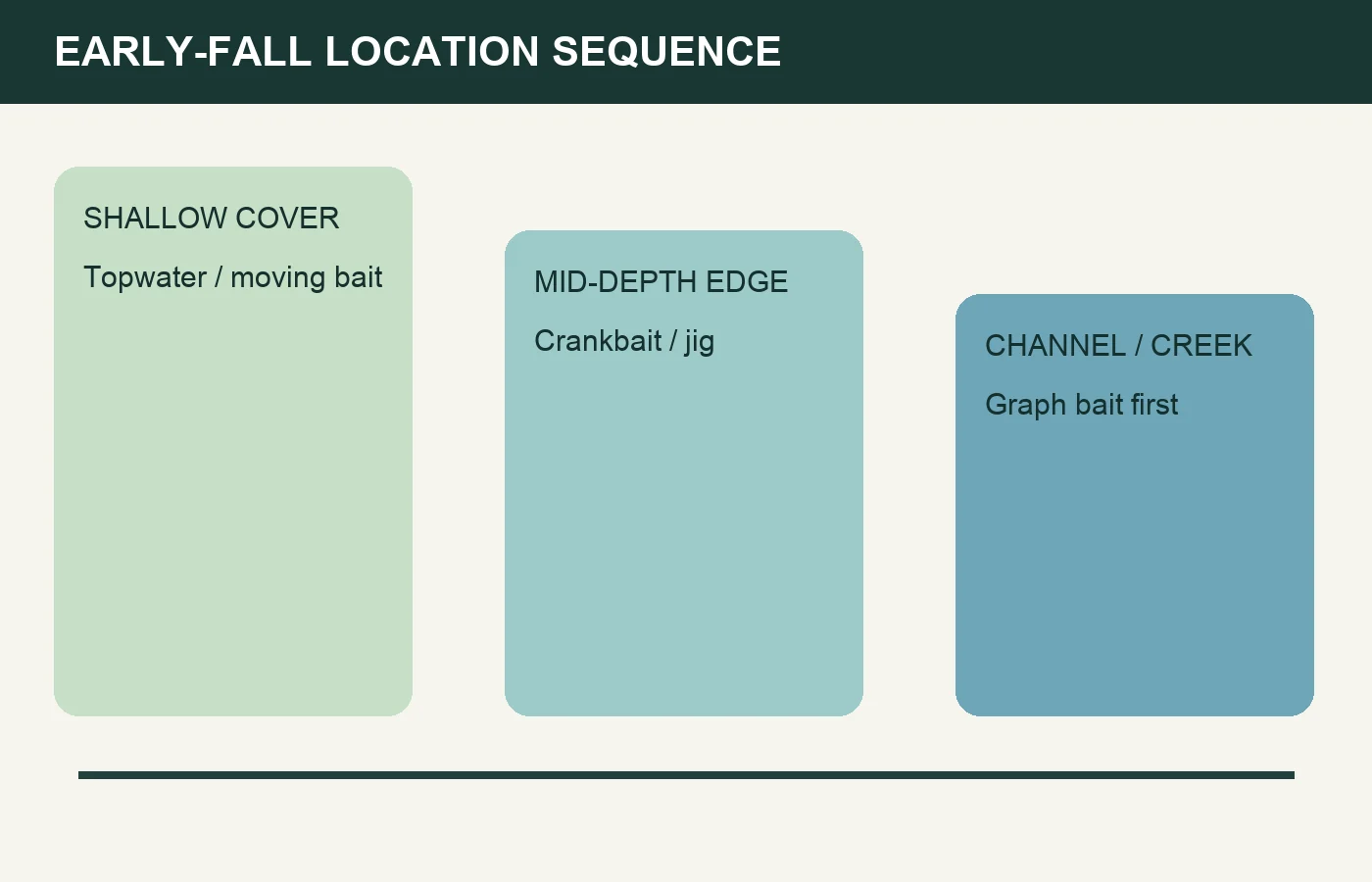
Where bass go in early fall
Bass do not all leave deep water together. Think in zones rather than a single destination.
| Zone | Clues to look for | First presentation |
|---|---|---|
| Main-lake summer area | Bait still deep, stable warm weather, fish on ledges or deep cover | Deep crankbait, football jig, or drop shot |
| Primary point or creek mouth | Bait crossing the break; wind or current hitting the feature | Crankbait, underspin, or swimbait |
| Secondary point or channel swing | Repeated bait groups; nearby hard cover | Jerkbait, spinnerbait, jig, or Texas rig |
| Shallow flat or pocket | Visible forage, birds, stained water, productive shade | Topwater, squarebill, spinnerbait, or soft jerkbait |
Reservoirs with shad often reward a creek-by-creek search. Natural lakes may center the transition around green vegetation, perch or sunfish, and the last healthy outside weed edge. River bass may respond more to current and water level than to a neat seasonal migration. The principle is the same: connect a reliable holding area to the best available food.
How water temperature should guide—not dictate—the plan
Surface temperature is useful context, but it is not a universal trigger. A reading at the ramp can differ from the back of a creek, the shaded side of a reservoir, or water several feet down. Use the trend over several days. Cooling nights and a sustained downward trend are more meaningful than a single reading after a thunderstorm.
During turnover, oxygen and temperature can become more uniform through the water column while decaying material and mixed water reduce clarity in some lakes. Sonar may look cluttered and bass can be difficult to pin to one depth. If the main basin looks lifeless, test areas with inflow, wind, green vegetation, or a strong shallow feeding opportunity. Do not treat turnover as an excuse to stop searching.
A half-day September plan
First light: test the feeding window
Cover a shallow flat, riprap stretch, grass line, or the mouth of a pocket with a topwater or fast moving bait. Keep the boat far enough off the cover to make long casts. If bass are missing a topwater, follow with a soft jerkbait or weightless stick bait.
Midmorning: follow the first break
Move to the closest secondary point, ditch, outside grass edge, or dock line with several depths available. A squarebill or shallow crankbait can search rock and wood; a spinnerbait or vibrating jig can search stained water and grass. Mark the depth of each bite.
Late morning: verify deeper water
If shallow cover is empty, idle the adjacent point, creek mouth, or channel edge. Use the process in our guide to fishing points and drop-offs. When electronics show bait close to cover, make a controlled pass with a swimbait, jig, or finesse rig instead of casting at every pixel.
Afternoon: repeat the strongest combination
Return to the best mix of depth, cover, bait, and wind. A pattern should be specific enough to repeat: “secondary points with chunk rock in eight to twelve feet” is useful; “fish were near shore” is not.
Conditions that change the route
Cold front
After a sharp front, shallow fish may hold tighter to dock posts, grass clumps, laydowns, or the first depth change. Keep checking the area, but slow down with a jig, Texas rig, or compact finesse bait after the moving-bait pass.
Warm stable spell
A run of warm afternoons can extend the summer position or create a short shallow feeding window without moving the whole population. Check both ends of the travel route before deciding the transition has reversed.
Wind
Wind can improve a bank by adding current, reducing light penetration, and concentrating forage. It can also make boat control and lure contact worse. Fish the wind when you can present safely and accurately; use the protected side when control becomes the limiting factor. Our windy-day bass fishing guide covers those adjustments.
Heavy rain or rising water
Fresh inflow can pull bait and bass toward creeks, drains, or newly flooded cover, but muddy cold runoff can also push fish to the clearer edge. Read how to fish after a hard rain before choosing the dirtiest water by default.
Common September mistakes
- Running straight to the backs of creeks. Check the migration route on the way in.
- Fishing memories instead of current clues. Last September’s productive pocket may not hold this year’s forage.
- Changing lures before changing water. If an area has no bait, cover, current, or fish marks, a different color is unlikely to fix it.
- Treating every sonar mark as bass. Use behavior, position, and repeat passes. Learn the display with our side imaging versus down imaging guide.
- Ignoring navigation safety. Falling water can expose timber and shallow bars. Slow down outside marked channels.
Simple tackle system for the transition
Carry one surface bait, one horizontal search bait, one bottom-contact bait, and one finesse follow-up. That is enough to cover the water column without turning every stop into a tackle decision. The companion early fall bass lure guide matches those roles to clarity, wind, cover, and bait depth. For a broader baseline, see the year-round bass lure system.
Sources and limits
- NOAA Fisheries: understanding fish habitat — habitat context.
- USGS Water Science School: lakes and reservoirs — lake structure and water-cycle context.
- National Weather Service safety resources — current weather and water safety planning.
Exact bass position varies by waterbody, forage, weather, water level, and fishing pressure. Treat the route in this guide as a testable search plan, not a promise that every lake follows the same calendar.
About the author
Josh is the founder and editor of The Anglers Hub. This article separates documented seasonal principles from editorial fishing strategy; it does not claim undisclosed product testing or private-location knowledge.
Primary research used for this guide
- Iowa DNR: Largemouth Bass — regional seasonal movement and diverse prey context; its temperature examples are not treated as national rules.
- Nebraska Extension: Fall Turnover — stratification and mixing mechanism.
- Texas Parks & Wildlife bass tracking study — evidence that many tracked fish used relatively small home areas instead of one synchronized bank-to-offshore migration.
Editor Note
Gear mentions and recommendations are independently evaluated from specifications, public product information, pricing, use-case fit, and upgrade paths unless a specific article states direct product experience.
More From The Hub
Best Early Fall Bass Lures: What to Throw as the Water Cools
Choose early fall bass lures by water clarity, wind, cover, bait depth, and fish activity with a practical seven-lure decision system.
Read More
Early Summer Bass Fishing: 7 Proven Tips for More Bites
Catch more bass in early summer with seven practical tips for timing, locations, lure choices, shade, bluegill beds, and deeper midday patterns.
Read More
How to Fish After a Hard Rain Without Guessing
Rain can move fish shallow, muddy up good banks, and create short feeding windows. Here is how to read runoff, mud lines, cover, and…
Read More