Choose early fall bass lures by water clarity, wind, cover, bait depth, and fish activity with a practical seven-lure decision system.
Quick answer: The best early fall bass lure is the one that reaches the baitfish at the speed the fish will tolerate. Start with a topwater at first light, a crankbait or spinnerbait to cover shoreline transitions, a swimbait or underspin for suspended bait, and a jig or soft plastic when bass hold tight to cover.
Reviewed: August 28, 2026 | Evidence: EDITORIAL ASSESSMENT based on lure function, seasonal habitat, and documented manufacturer use. No lure in this guide is presented as a controlled-test winner.
Early fall is a location problem before it is a lure problem. Bass may be deep on a point in the morning, chasing bait on a flat at noon, or buried in shallow cover after a front. Instead of carrying twenty “fall colors,” carry a small set of tools that cover speed, depth, and cover.
Choose by conditions, not by the month
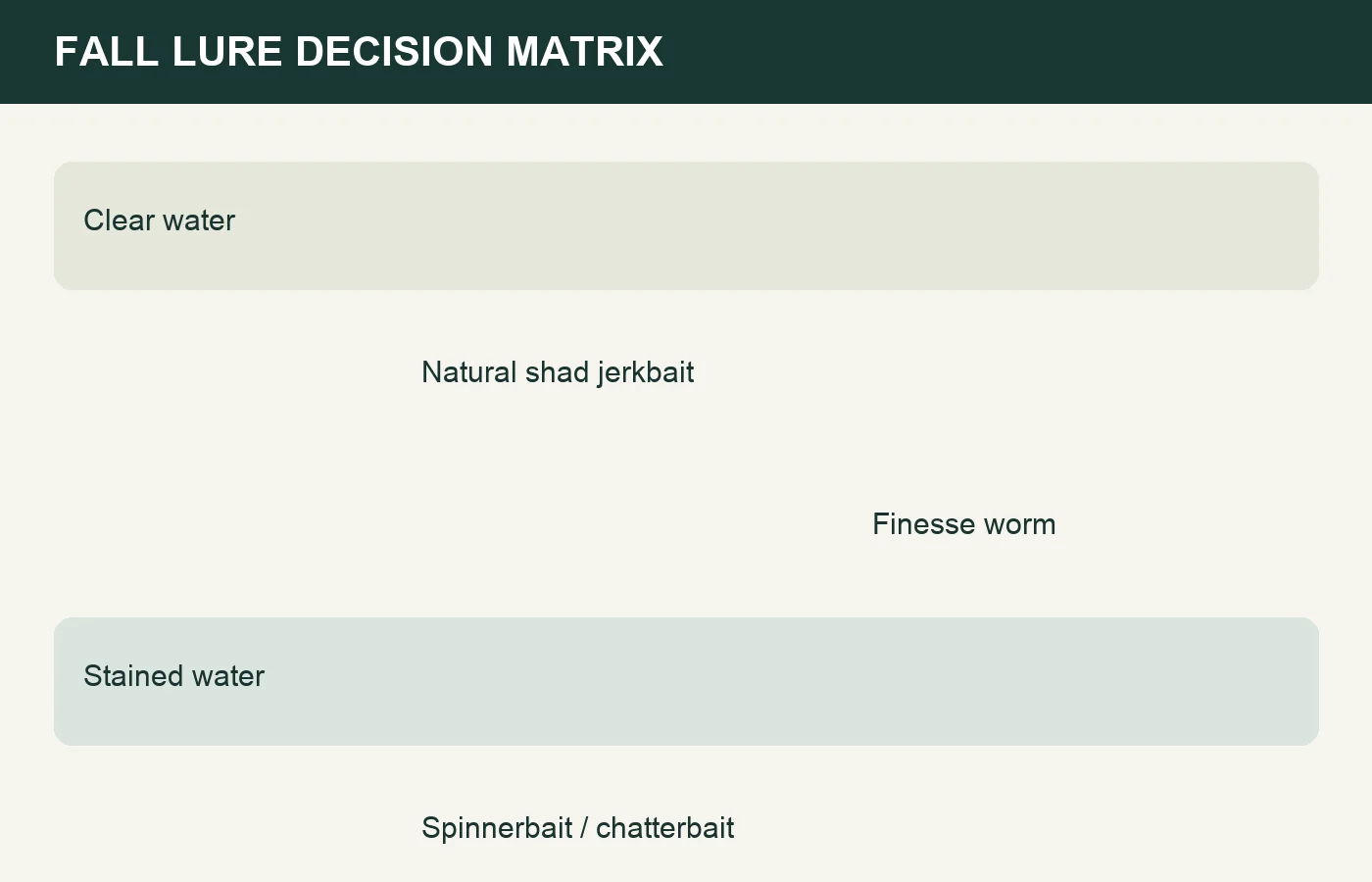
| Condition | Start with | Follow with | Key adjustment |
|---|---|---|---|
| Clear and calm | Natural jerkbait or small swimbait | Finesse worm | Long casts; lighter line where cover allows |
| Stained with wind | Spinnerbait or vibrating jig | Dark compact jig | Add vibration and keep the bait near cover |
| Bait on the surface | Walking topwater or popper | Soft jerkbait | Match forage size before changing color |
| Bait suspended off a point | Swimbait, underspin, or jerkbait | Drop shot | Count the lure down to the observed depth |
| Bass tight to wood or grass | Squarebill or spinnerbait | Texas rig or jig | Deflect first, then pick the cover apart |
1. Walking topwater: fast coverage over active fish
A walking bait can cover flats, long points, seawalls, and schooling areas quickly. It is most useful when bass are looking up: low light, wind ripple, overcast weather, or visible forage near the surface. Use a popper when the strike zone is small—beside a dock corner, laydown, or isolated grass clump.
Mistake to avoid: staying with surface activity after the bait has dropped. Keep a soft jerkbait or small swimbait ready to follow fish that miss or stop breaking.
2. Squarebill crankbait: deflection around shallow cover
A squarebill earns a place when early fall bass move to riprap, laydowns, stumps, and shallow channel swings. Choose a model that reaches the cover without digging too far below it. Contact is the point: tick the rock, glance off wood, or catch the outside edge of grass, then pause or change speed.
Use a tighter, subtler action in clear or cooling water and a wider, noisier profile in stained water when bass need help locating the lure. Color comes after visibility and forage profile. Shad patterns are a practical baseline; craw or chartreuse accents can help around rock or dirty water.
3. Spinnerbait: wind, stain, and awkward cover
A spinnerbait stays relatively manageable through branches, grass gaps, and waves. In clear water, use a compact natural skirt and faster retrieve. In stain, add contrast and thump. Willow blades generally favor speed and flash; rounder blades add lift and vibration. Those are functional tradeoffs, not rules that override what the fish show.
Keep the lure in the productive depth. “Slow rolling” still requires blade rotation; if the bait collapses or drags, change weight, blade size, or retrieve angle.
4. Jerkbait: suspended bass and clear-water followers
A suspending jerkbait can reach bass following bait across a point, creek mouth, or standing timber. Begin with a steady cadence while the water remains warm, then lengthen the pause after a front or as water cools. Watch the lure beside the boat: hooks, leader, water temperature, and salinity can change whether a bait rises, sinks, or suspends.
In very clear water, long casts help. In stained water, a spinnerbait, crankbait, or vibrating jig usually creates a clearer target.
5. Paddle-tail swimbait or underspin: follow the bait depth
A small paddle tail is one of the simplest ways to imitate open-water forage. Rig it on a plain jig head around schooling fish or use an underspin when extra flash helps. Select weight to maintain depth, not to maximize casting distance. If bait is twelve feet down, count the lure and hold that zone through most of the retrieve.
For fish near the bottom, let the bait make occasional contact. For suspended fish, keep the retrieve horizontal. Electronics can shorten the guesswork; start with choosing a small-boat fish finder or learn how to read side imaging for bass.
6. Football or compact casting jig: slow down on hard targets
A football jig can probe rock, points, and deeper transitions. A compact casting jig is better around docks, wood, and mixed cover. Start natural in clear water and add a darker silhouette as visibility falls. Trailer size changes fall rate and profile more than a minor color variation.
After a moving bait produces one bite, make several bottom-contact casts through the exact target. That turns a search lure into a way to locate a small group.
7. Texas rig or finesse worm: the reset button
A Texas-rigged worm reaches grass, brush, docks, and laydowns with fewer snags. A drop shot or shaky head handles pressured fish on cleaner bottom. These are not only “last resort” lures: they are precise tools when bass are visible on electronics but will not chase.
Use the lightest weight that maintains contact and control. Too light drifts above the target; too heavy can bury in soft bottom or grass. Line choice depends on cover and clarity, so compare braid, fluorocarbon, and mono before copying a universal setup.
A four-rod early fall system
- Rod 1: topwater or jerkbait for surface and suspended fish.
- Rod 2: squarebill, spinnerbait, or vibrating jig for cover and wind.
- Rod 3: swimbait or underspin for baitfish depth.
- Rod 4: jig, Texas rig, or finesse worm for targets that deserve a slower pass.
This system is intentionally seasonal. The year-round bass lure guide covers a broader core box, while spring-spawn lure selection addresses a different search intent. For location, use the companion September fall bass transition plan.
Color and size without the mythology
Choose profile first. If the forage is small, a compact bait often gets more complete strikes than a full-size lure. Then match contrast to visibility: translucent or natural patterns in clear water; stronger silhouettes, flash, or chartreuse accents in stain. Finally, adjust only one variable at a time. Changing lure, color, depth, and retrieve together teaches you nothing.
Common mistakes
- Buying “fall colors” without finding forage.
- Fishing every lure at the same depth.
- Choosing heavy tackle that kills action or light tackle that cannot control fish in cover.
- Leaving productive structure after one fish instead of making a second, slower pass.
- Turning a location failure into endless color changes.
Sources and evidence
- NOAA Fisheries: understanding fish habitat — habitat context.
- USGS Water Science School: lakes and reservoirs — lake and seasonal water context.
- Manufacturer lure pages may document depth, weight, buoyancy, and hook configuration. Verify the exact model; marketing claims are not treated as independent performance evidence.
About the author
Josh is the founder and editor of The Anglers Hub. This guide is an editorial decision framework. It does not claim that every lure was tested head-to-head or that one brand always outperforms another.
Primary technique sources
- Iowa DNR: Largemouth Bass — water-clarity adjustments and soft-plastic follow-up context.
- Virginia DWR: Fall Smallmouth Bass Fishing — explicitly river-smallmouth guidance for topwater, flukes, and swimbaits.
- New Jersey Fish & Wildlife: Largemouth Bass — regional fall forage-chasing and spinnerbait/crankbait guidance.
- Tennessee Wildlife Resources Agency: Nickajack Reservoir — waterbody-specific grass, lipless-crankbait, and Texas-rig examples.
Editor Note
Gear mentions and recommendations are independently evaluated from specifications, public product information, pricing, use-case fit, and upgrade paths unless a specific article states direct product experience.
More From The Hub
Fall Bass Fishing Transition: How to Find Bass in September
A practical September search plan for following bait, connecting summer areas to fall feeding zones, and adjusting to wind, fronts, and turnover.
Read More
Early Summer Bass Fishing: 7 Proven Tips for More Bites
Catch more bass in early summer with seven practical tips for timing, locations, lure choices, shade, bluegill beds, and deeper midday patterns.
Read More
How to Fish After a Hard Rain Without Guessing
Rain can move fish shallow, muddy up good banks, and create short feeding windows. Here is how to read runoff, mud lines, cover, and…
Read More