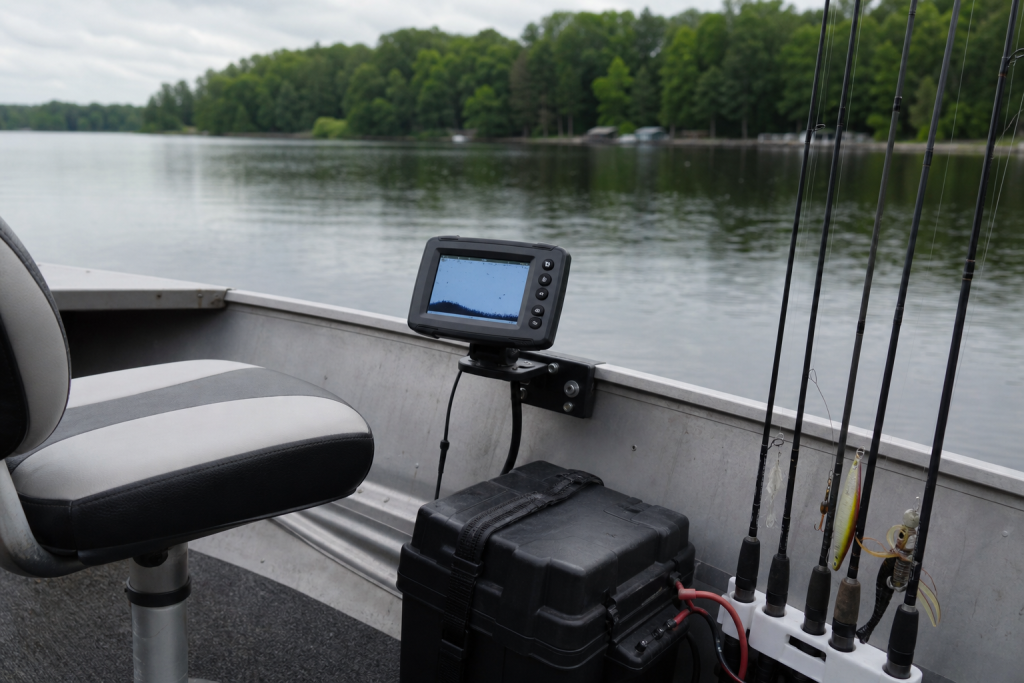
A practical small-boat fish finder guide covering screen size, sonar, GPS, mounting, power, and budget decisions before you buy.
Quick answer: This guide explains how to choose a fish finder in practical terms, including the key choices, common mistakes, and on-the-water details anglers should understand before the next trip.
A good fish finder for a small boat should be easy to read, simple to power, and matched to the way you actually fish. Most jon boats, small aluminum boats, skiffs, and compact bass boats do best with a 5- to 7-inch display, reliable CHIRP sonar, GPS mapping if you fish bigger water, and a transducer mount that stays in clean water at fishing speed.
The goal is not to buy the biggest unit you can afford. The goal is to buy a fish finder that fits your boat, battery system, mounting space, and fishing style.
Quick answer: what most small boats need
For most small-boat anglers, start with this setup:
- Screen size: 5 inches minimum; 7 inches if budget and console space allow.
- Sonar: CHIRP 2D sonar for depth, bottom, bait, and fish arches.
- Imaging: Down imaging is useful; side imaging is excellent if you fish structure and have room in the budget.
- GPS: Worth it if you fish lakes, reservoirs, rivers, or unfamiliar water.
- Transducer mount: Transom mount for most small boats; trolling motor mount for bow-focused bass fishing.
- Power: Dedicated marine battery or clean accessory circuit with proper fuse protection.
- Budget: Under $300 for basic sonar/GPS; under $500 for stronger screens and imaging features.
If you are still comparing prices, start with the current budget guides:
Match the fish finder to the boat first
Small boats create different electronics problems than full-size bass boats. You usually have less dash space, less battery capacity, more vibration, and fewer clean mounting locations.
Before choosing a model, look at five constraints:
- Where the display will mount
- Where the transducer can sit in clean water
- How the unit will be powered
- Whether you need GPS and mapping
- Whether the screen is readable from your fishing position
A fish finder that looks great on a spec sheet can be frustrating if it blocks your tiller handle, drains a small battery, or forces the transducer into turbulent water.
Choose the right screen size
A 5-inch fish finder is the practical minimum for a small boat. It keeps cost and power draw down while still giving you enough screen to read sonar and basic mapping.
A 7-inch unit is usually the better long-term choice if you can afford it. The bigger display helps when you split the screen between sonar and mapping, or between side imaging and down imaging.
Use this rule:
- 5-inch display: best for tight budgets, small jon boats, simple sonar, and short trips.
- 7-inch display: best all-around size for small boats.
- 9-inch display: useful if you run mapping and imaging heavily, but often overkill for very small boats.
If your boat has no console, mock up the display location with cardboard before buying. Make sure you can see it from the seat or casting deck without leaning over.
Decide which sonar features matter
Most anglers do not need every sonar feature on day one. Start with the way you fish.
CHIRP sonar
CHIRP sonar is the baseline feature to look for. It helps show depth, bottom hardness, bait, and fish returns under the boat. For small boats, it is useful everywhere: ponds, lakes, rivers, reservoirs, and inshore water.
Down imaging
Down imaging gives a more picture-like view beneath the boat. It helps identify brush, rocks, grass edges, bridge pilings, and other structure. If you fish around cover, it is worth having.
Side imaging
Side imaging scans out to the sides of the boat. It is powerful for finding structure, docks, grass lines, rock transitions, and bait without driving directly over them. It is especially useful for bass fishing, but it usually costs more and requires careful transducer placement.
If you are deciding between imaging types, read: Side Imaging vs Down Imaging.
Decide whether you need GPS
GPS is one of the most useful upgrades on a small-boat fish finder. Even if you do not need premium lake maps, GPS lets you mark waypoints, follow trails, return to productive spots, and navigate more confidently.
GPS is worth paying for if you:
- Fish bigger lakes or reservoirs
- Fish offshore structure
- Return to brush piles, rock piles, channels, or humps
- Fish rivers with ramps, cuts, or backwaters
- Want to mark hazards or productive banks
You can skip GPS if you only fish small private ponds or always stay in sight of the launch. But for most small-boat anglers, GPS becomes useful fast.
Think through transducer placement before buying
Transducer placement determines how clean your sonar picture will be. On small boats, the easiest option is usually a transom-mounted transducer. It works well when mounted low enough to stay in clean water but not so low that it throws spray or gets damaged.
Common options include:
- Transom mount: best default for jon boats and aluminum boats.
- Trolling motor mount: good for bow anglers who fish slowly and cast at targets.
- Portable arm mount: useful for rented boats, temporary setups, and some kayaks.
- Through-hull or shoot-through setup: more specialized and less common on basic small boats.
Before drilling holes, review the basics in the Transducer Placement Guide.
Plan the power setup
Small boats often have simple electrical systems, so power planning matters. A fish finder should have clean power, proper fuse protection, and wiring routed away from sharp edges or high-interference areas.
For basic units, many anglers use a small dedicated battery. For larger displays, side imaging units, or long trips, battery capacity becomes more important.
At minimum:
- Use the fuse size recommended by the manufacturer.
- Keep connections clean and protected from water.
- Avoid loose alligator clips as a permanent setup.
- Route wiring so it cannot be stepped on, pinched, or pulled.
- Charge the battery fully before each trip.
For full setup basics, use the Fish Finder Installation Guide.
Budget: what you get under $300 vs under $500
A small-boat fish finder does not have to be expensive, but the price range affects screen size, mapping, imaging, and upgrade path.
Under $300
This range is best for beginners and simple setups. Expect smaller screens, basic CHIRP sonar, and sometimes GPS plotting. It is enough for depth, bottom reading, and learning how fish relate to structure.
Best fit:
- First fish finder
- Small jon boat
- Pond and small-lake fishing
- Simple depth and sonar needs
See: Best Fish Finders Under $300.
Under $500
This range opens the door to better screens, stronger imaging options, and more useful mapping features. It is often the sweet spot for serious small-boat anglers.
Best fit:
- Regular weekend anglers
- Small bass boats
- Kayak or jon boat anglers who want imaging
- Buyers who want a unit they will not outgrow immediately
See: Best Fish Finders Under $500.
Small boat fish finder buying checklist
Before you buy, confirm these points:
- The screen fits where you plan to mount it.
- You can read the display from your normal fishing position.
- The transducer can be mounted in clean water.
- The unit has CHIRP sonar at minimum.
- GPS is included if you fish bigger water or mark spots.
- The battery can handle your trip length.
- The wiring path is safe and protected.
- The mount is stable enough for chop, vibration, and trailering.
- The unit matches your fishing style, not just the highest advertised feature count.
Common mistakes to avoid
Buying too small of a screen
A very small screen may work for basic depth, but it becomes limiting when using mapping or split-screen sonar. If you can stretch to 7 inches, it is usually worth it.
Ignoring the transducer
The transducer is not an afterthought. Poor placement can make an expensive unit look bad. Plan the mount before buying.
Paying for features you will not use
Forward-facing sonar compatibility, premium networking, and oversized screens are useful for some anglers, but not everyone needs them. Spend first on the features that match your boat and water.
Underestimating power needs
Weak batteries and poor wiring cause shutdowns, flickering, and unreliable readings. Clean power matters.
Final recommendation
For most small boats, the best fish finder setup is a 5- to 7-inch unit with CHIRP sonar, GPS, and either down imaging or side imaging depending on budget. If you fish structure-heavy lakes or bass water, side imaging is worth considering. If you mostly need depth, bottom detail, and simple waypoint marking, a budget CHIRP/GPS unit can be enough.
Start with the boat, not the feature list. A properly mounted, easy-to-read midrange fish finder will help more than an oversized unit installed in the wrong place.
FAQ
Is a 5-inch fish finder big enough for a small boat?
Yes, a 5-inch unit can work well for basic sonar and GPS. A 7-inch screen is better if you plan to use split-screen views, mapping, or imaging often.
Do I need side imaging on a small boat?
Not always. Side imaging is valuable for finding structure and cover, especially for bass fishing, but it costs more and requires careful transducer placement. CHIRP and down imaging are enough for many beginners.
Can I run a fish finder from a small battery?
Yes, many small fish finders can run from a compact dedicated battery. Larger screens and imaging units draw more power, so check the unit’s current draw and match the battery to your trip length.
Where should the transducer go on a jon boat?
Most jon boats use a transom-mounted transducer. It should sit where it gets clean water flow and stays protected from impact. Avoid mounting directly behind turbulence, rivets, or strakes when possible.
What is the best budget range for a small-boat fish finder?
Under $300 is good for basic sonar and beginner setups. Under $500 is usually the better value range if you want a larger screen, imaging, or stronger mapping features.
Budget small-boat electronics extras
Pair any graph with clean power, mounting, and map storage—the parts many buyers forget.
Transom Mount Transducer Bracket
Price:Under $20
Adjustable transducer bracket for small boats and jon boats when you need clean sonar water.
- Easy install
- Works with common transducers
- Budget rigging fix
Attwood Battery Box Small
Price:Under $25
Basic 12V battery box for fish finders and small electronics on jon boats and kayaks.
- Secure hold-down
- Ventilated design
- Common size for group 27 batteries
SanDisk Ultra microSD 32GB
Price:Under $12
Map and waypoint storage for Garmin, Humminbird, and Lowrance units that use microSD cards.
- Widely compatible
- Enough space for regional maps
- Inexpensive spare card
As an Amazon Associate we earn from qualifying purchases.
Fish finder setup and sonar basics
Use these related Anglers Hub guides to keep building the same skill set:
Editor Note
Gear mentions and recommendations are independently evaluated from specifications, public product information, pricing, use-case fit, and upgrade paths unless a specific article states direct product experience.
More From The Hub
Kayak Fish Finder Battery Runtime and Wiring Guide
Estimate fish finder battery runtime and build a safer kayak electronics circuit with correct voltage, usable capacity, fusing, wire, and connectors.
Read More
How to Read Side Imaging for Bass
Learn how returns, acoustic shadows, range, frequency, speed, and transducer setup affect what bass, baitfish, brush, rock, and grass look like.
Read More
A Simple Freshwater Fishing Setup That Covers Most Trips
Build one versatile beginner freshwater spinning setup with the right rod, reel, line, lures, drag, knots, and pre-trip checklist.
Read More